 TradeAdapt
The TradeAdapt Difference
- Adapts to Market Structure in Real-Time
- Multi-Timeframe Confirmation
- Cross-Market Dashboard
- Same Math Institutions Use
🎥 Watch the Video Breakdown
See how Multi-Timeframe Adaptive Fibonacci works in real-time
What Makes This Different
It’s Reactive, Not Predictive
The system doesn’t predict price. It observes structure, calculates adaptive levels from that structure, and shows when alignment exists. You’re reading what’s already there.
It Adapts in Real Time
Traditional Fibonacci tools draw static levels from old swing points. Adaptive Fib recalculates as new ranges form. You see today’s structure, not yesterday’s.
It Layers Timeframes
Monthly, Weekly, and Daily structure on a single chart. When timeframes agree, you have an edge. When they conflict, you have noise — avoid it.
It Works Across Every Market
Same framework on futures, forex, crypto, equities, and commodities. Learn it once, apply everywhere.
A Real NQ Setup, Step by Step
Not theory. Not backtests. Real structure on real charts.
1. The Long-Term View
Start with where price is in higher-timeframe structure.
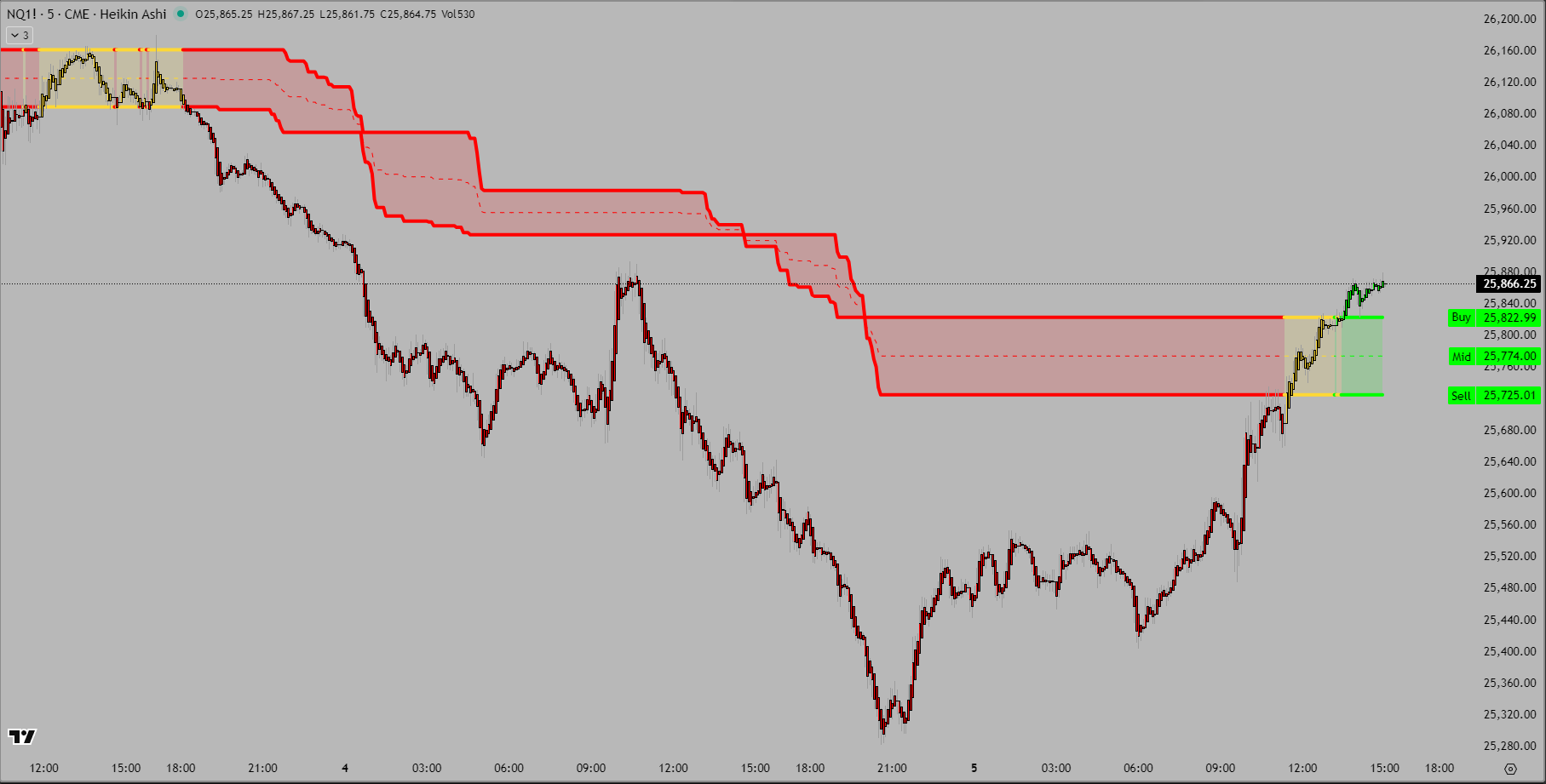
5-min NQ chart with Weekly Buy and Sell levels (click to enlarge)
Two horizontal lines define the weekly battleground:
- Weekly Buy — bulls must hold above this. Break above = bullish structure confirmed.
- Weekly Sell — bears must break below this. Break below = bearish structure confirmed.
Higher-timeframe structure (where institutions operate) on a lower-timeframe chart (where you execute). Institutional context with tactical timing.
2. Adding Targets
The market doesn’t move randomly. It moves to specific levels where liquidity concentrates.
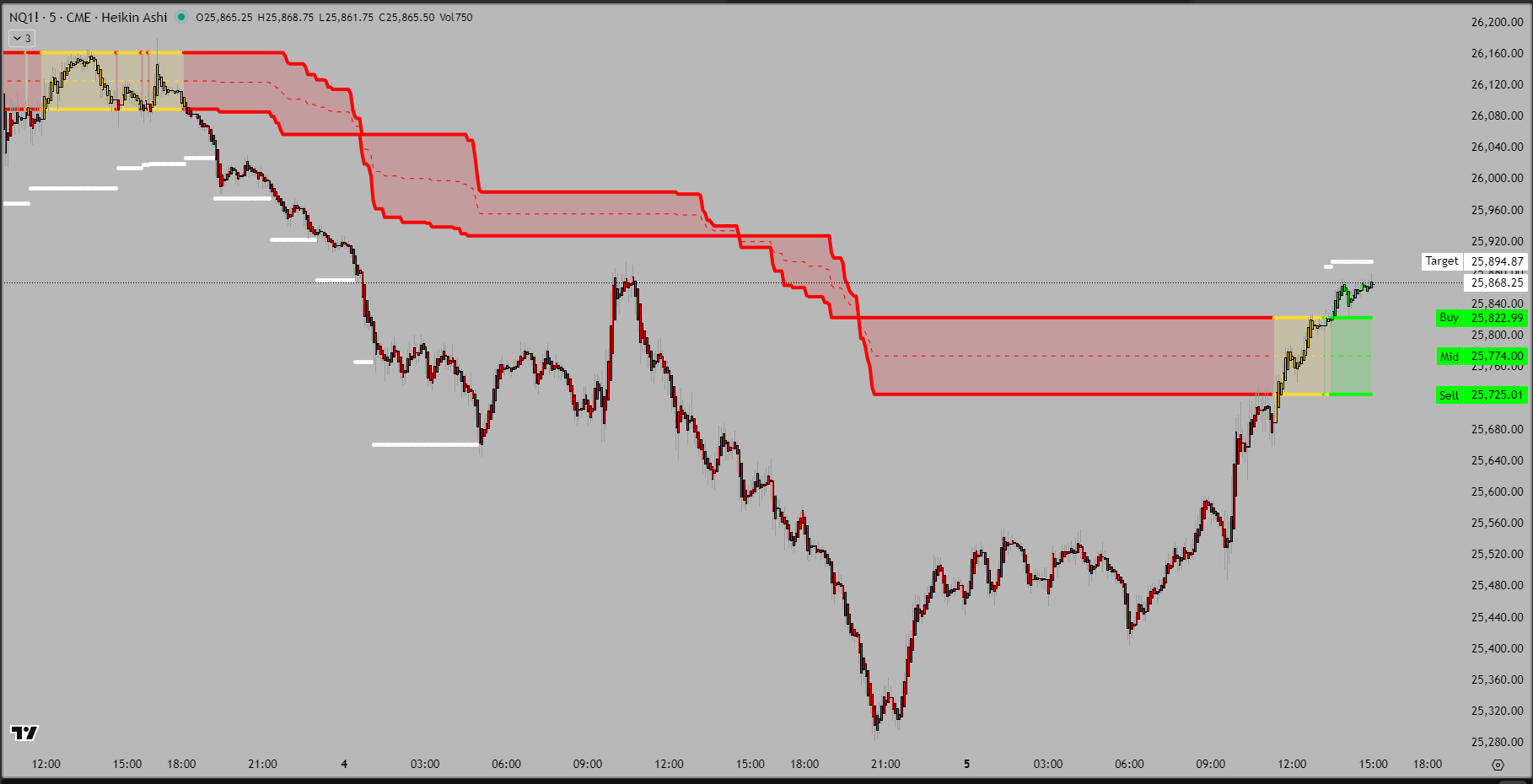
Weekly Buy/Sell with Mid line and Fibonacci targets (click to enlarge)
The white labels mark Fibonacci-based targets calculated from the weekly range. Same math used by trading desks worldwide. These aren’t arbitrary — they’re where orders cluster, where price pauses or reverses, and where you have objective points to scale out, add, or tighten stops.
3. Expansion Zones
Where moves either accelerate or exhaust.
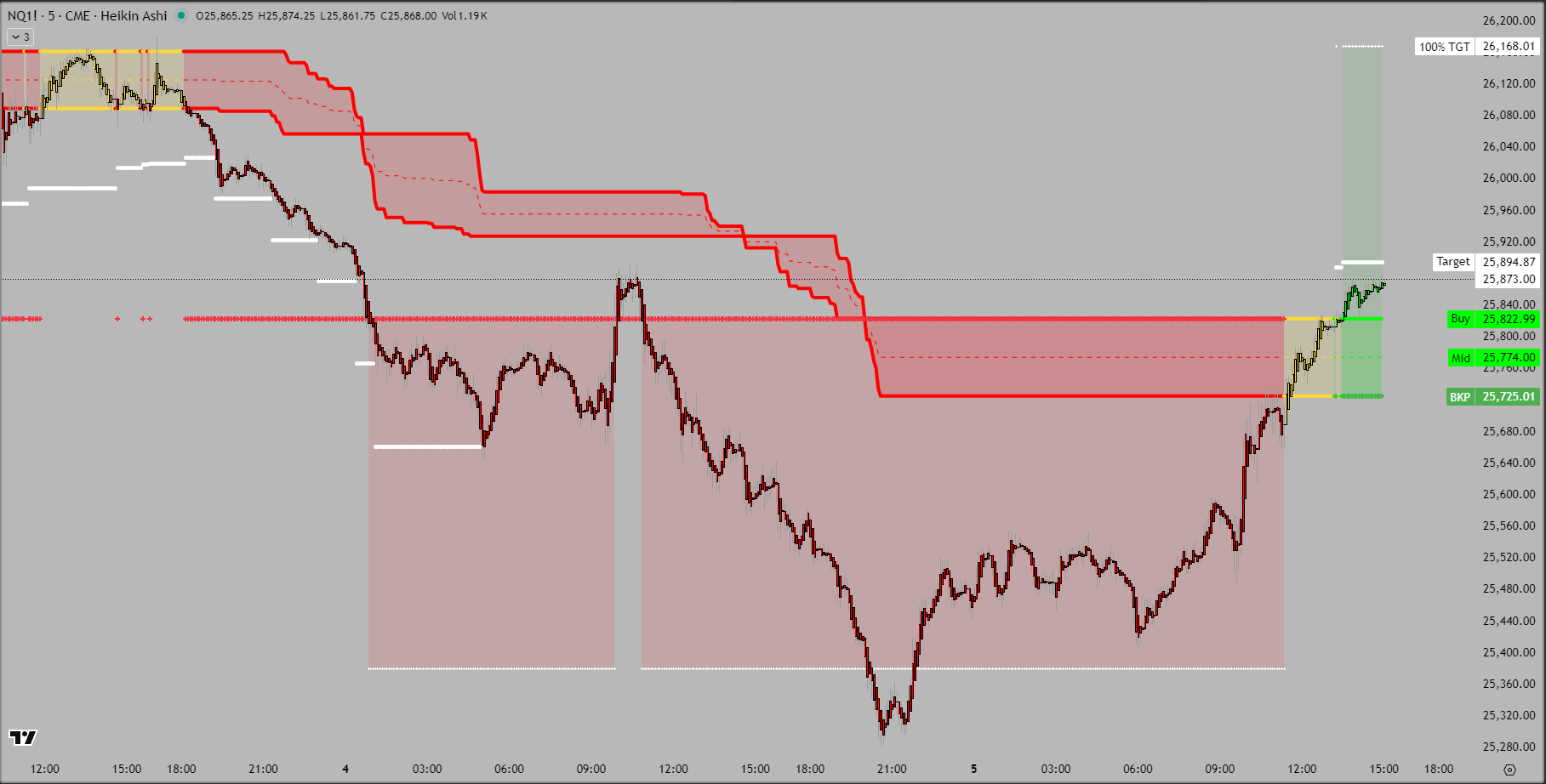
Full weekly structure: Buy, Sell, Mid, Targets, Expansion Points, 100% target (click to enlarge)
The dashed lines are the Expansion Points — where moves either push through with conviction or reverse hard. When price reaches the 100% target with time remaining in the period, momentum typically continues through period end. Mid-week 100% breaks are the highest-conviction continuation setups.
4. Daily Structure Flips
Where bears lose control and bulls take over.
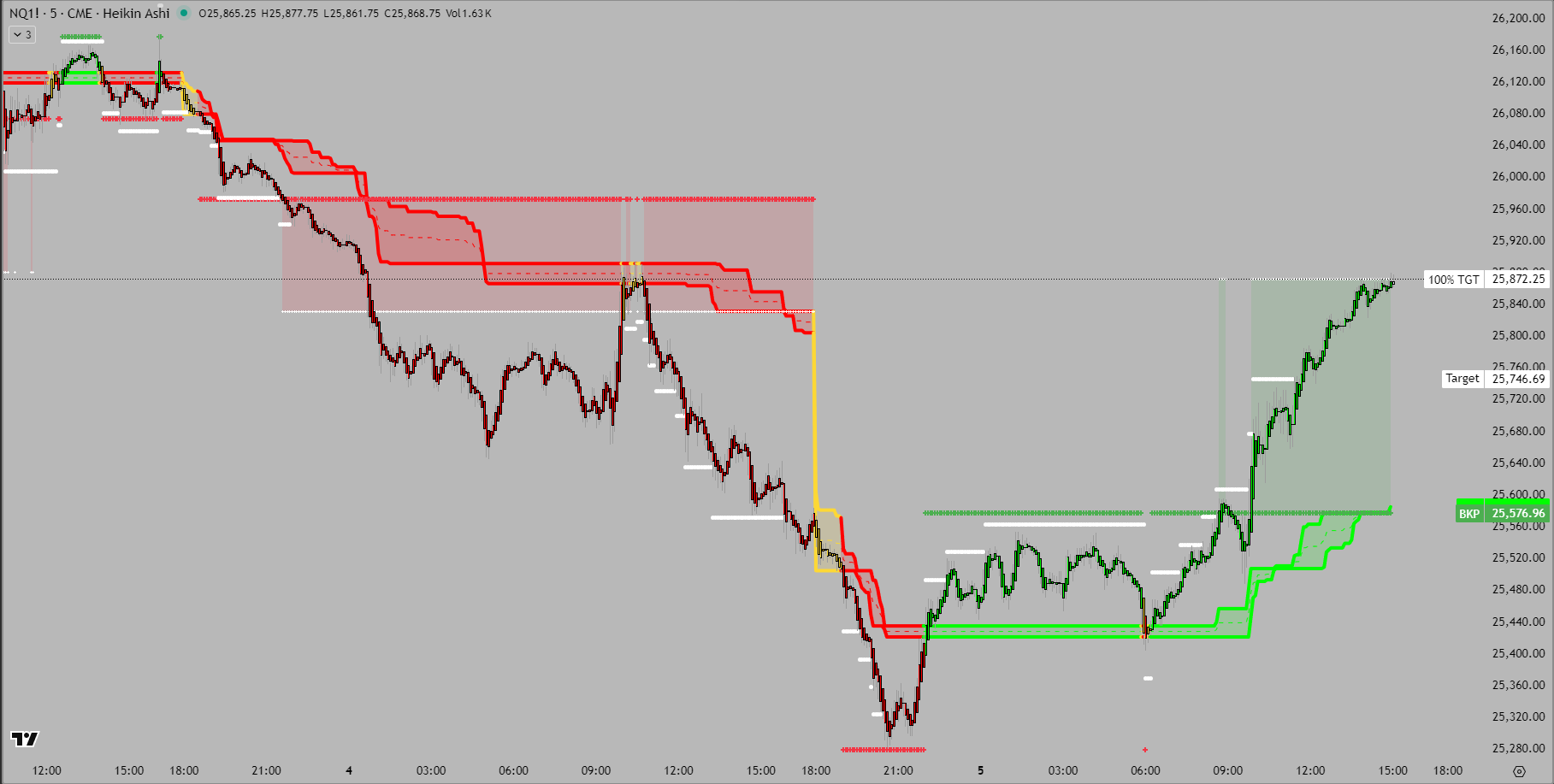
Daily timeframe: red bearish zones giving way to green bullish zones (click to enlarge)
Strong reversals don’t happen all at once. Price reclaims levels methodically — bouncing from the BKP expansion low, breaking back above Monthly Sell, reclaiming Mid, then pushing toward Monthly Buy. Each level held becomes new support. This is textbook institutional accumulation.
5. Full Timeframe Alignment
When all timeframes agree, probability shifts dramatically.
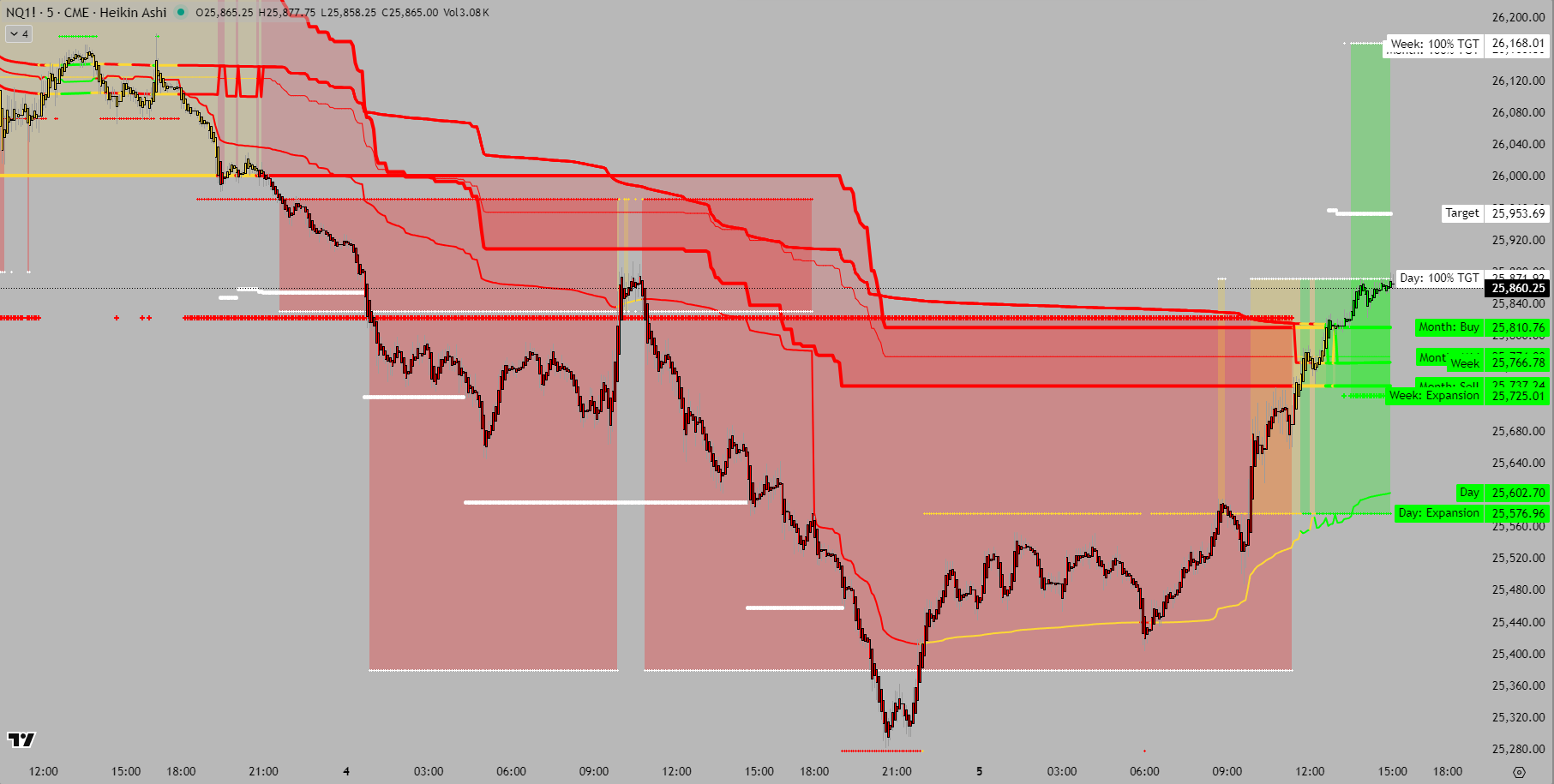
Daily, Weekly, and Monthly Adaptive Fib levels combined on a single 5-min chart (click to enlarge)
Top-down approach:
- Monthly first — long-term structure, where institutions are positioned
- Weekly second — intermediate trend, filters daily noise
- Daily last — execution timing within established structure
6. The Market Dashboard
Same levels, different view.
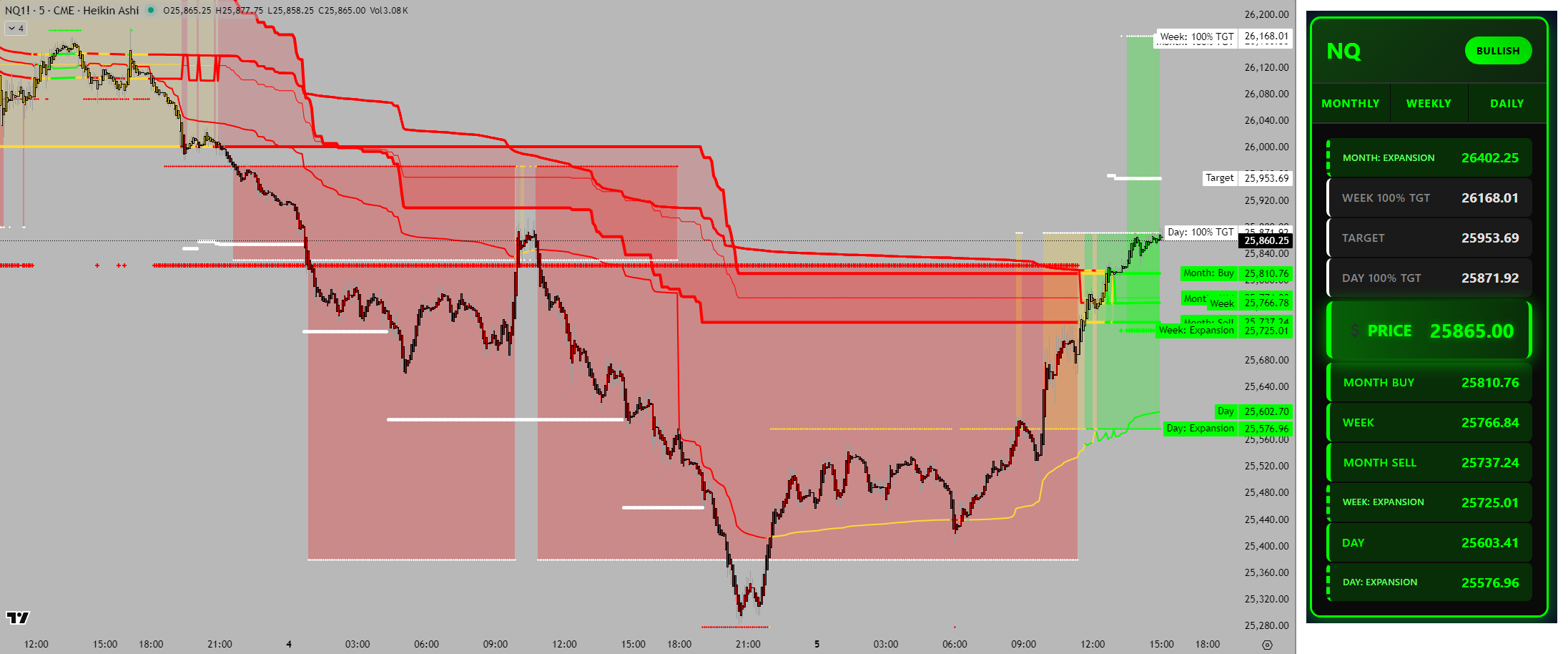
Multi-timeframe chart paired with dashboard card for the same instrument (click to enlarge)
The chart shows you where price is in structure visually. The dashboard shows you what the structure is numerically — exact prices, alignment status, instant confirmation. Together: complete situational awareness.
7. Reading the Dashboard Card
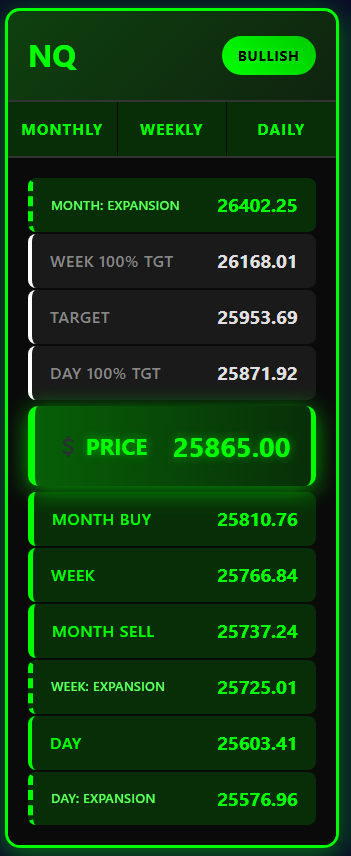
NQ dashboard card: alignment badge, timeframe status, and full price stack (click to enlarge)
One glance gives you everything:
- Alignment badge — BULLISH (green), BEARISH (red), or MIXED (yellow)
- Timeframe status bar — Monthly / Weekly / Daily color state
- Price stack — sorted high to low, current price highlighted, levels above are resistance/targets, levels below are support
Color coding: green solid = bullish levels, green dashed = expansion zones, white/gray = targets.
8. Multi-Market Confirmation
The strongest signal: when correlated markets all agree.
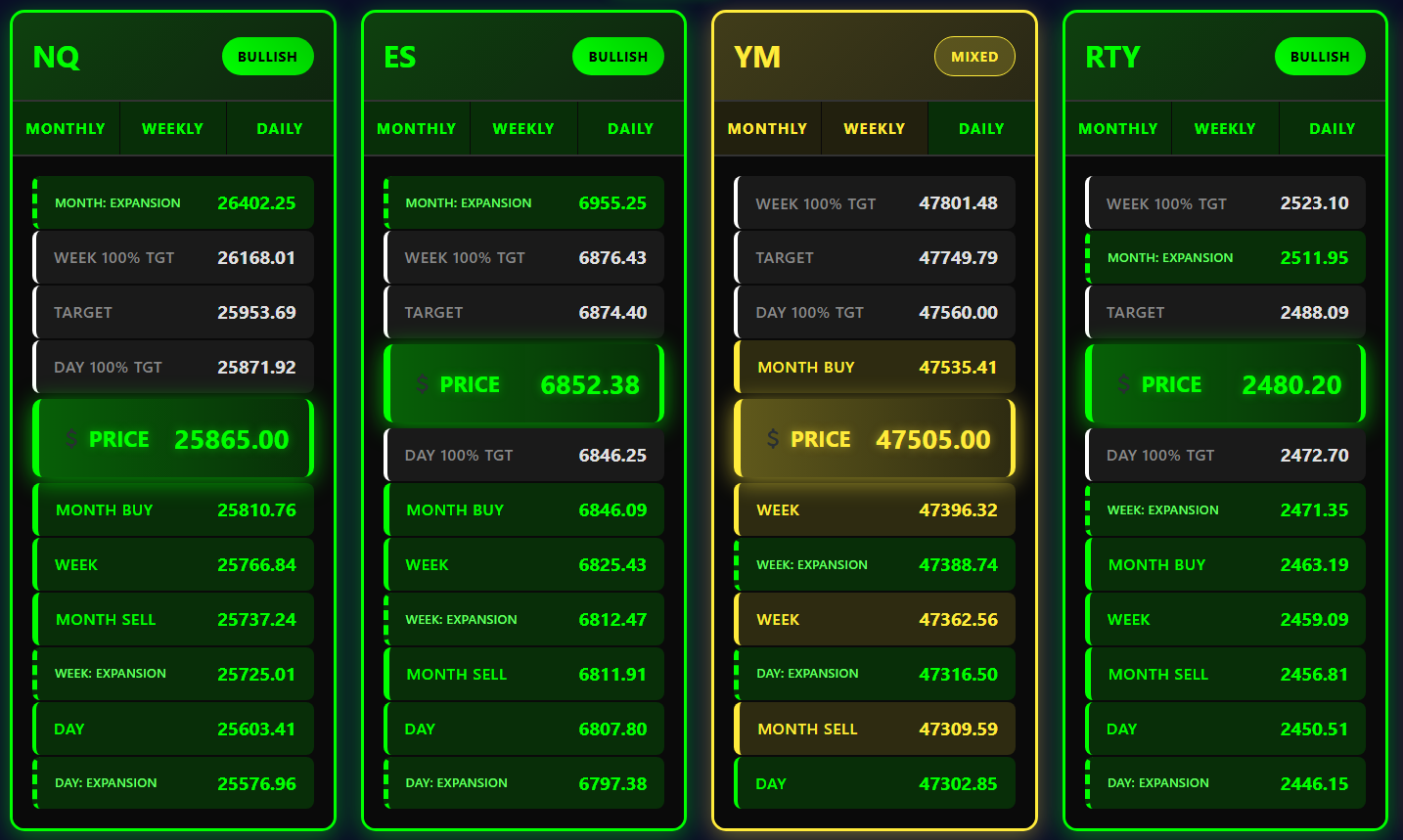
NQ, ES, YM, RTY side by side — coordinated bullish structure across major US indices (click to enlarge)
Three of four major US equity indices showing full bullish alignment. YM the only laggard at MIXED — but its Daily timeframe is already green. This is institutional consensus: big money is buying across the board, not just one index. Convergence signals strength.
Global Confluence
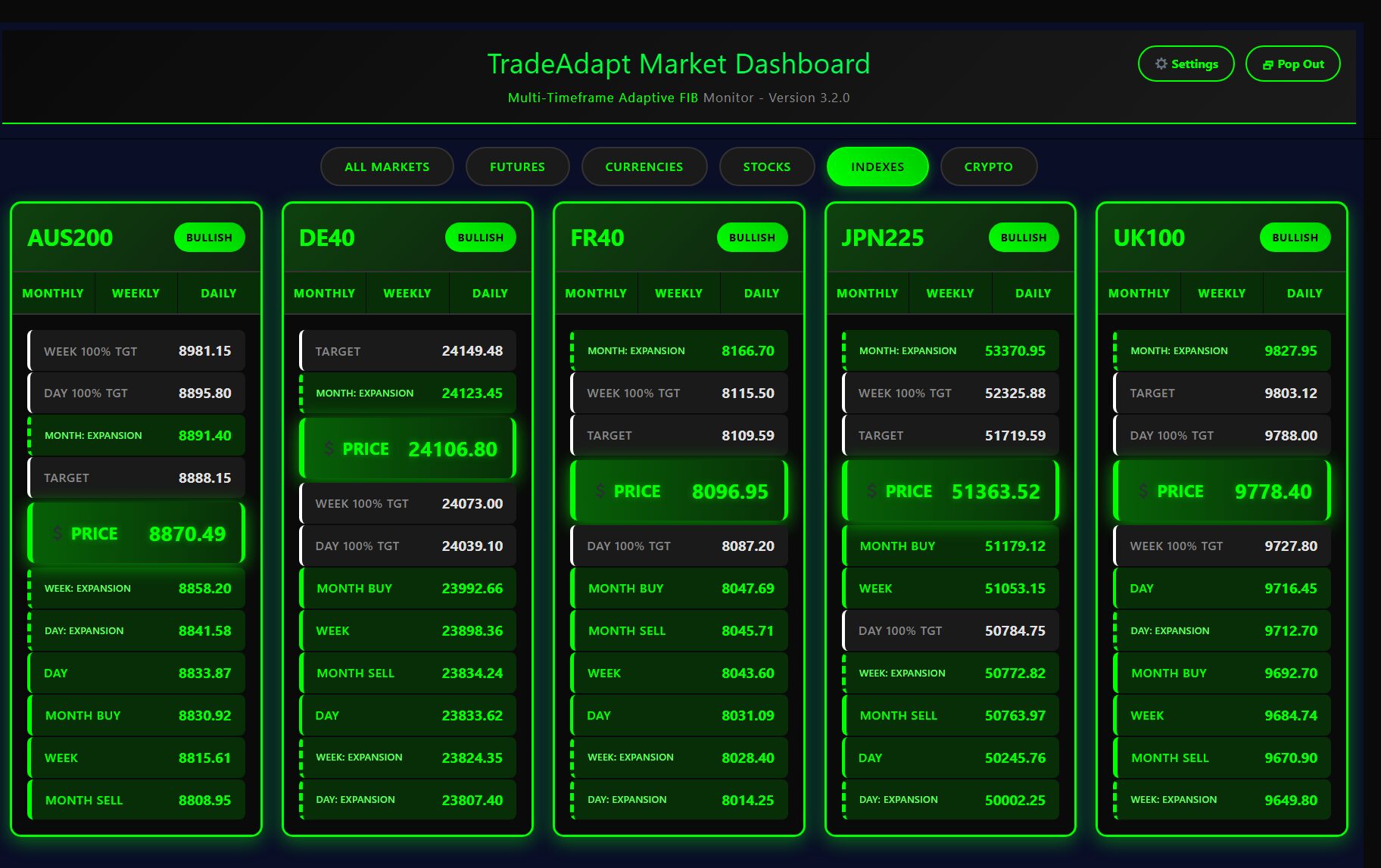
AUS200, DE40, FR40, JPN225, UK100 — international confirmation (click to enlarge)
When alignment extends beyond US indices to global markets — DAX, FTSE, Nikkei, ASX — you have global institutional capital flowing the same direction. The strongest moves happen when the entire world agrees.
The Trade in Five Phases
Phase 1 — Breakdown. NQ breaks below Monthly Sell. All three timeframes red. Stay flat or short.
Phase 2 — Inflection. Price reaches Monthly Expansion (BKP), holds instead of breaking through. First exhaustion signal.
Phase 3 — Reversal. Price breaks back above Monthly Sell. Daily flips green, then Weekly, then Monthly. Each flip adds conviction.
Phase 4 — Climb. Price grinds higher through each level. Former resistance becomes support. Dashboard shows full BULLISH alignment.
Phase 5 — Multi-Market Confirmation. ES and RTY also BULLISH. YM MIXED but Daily green. Maximum conviction zone.
The Numbers
- Low at expansion target: ~25,300
- Dashboard snapshot: ~25,865 (565 points off the low)
- Next target: 25,953
- Week 100% target: 26,168
- Month expansion: 26,402
Total potential range from low to month expansion: 1,102 points. The system didn’t predict it — it showed the structure as it formed.
The Five Lessons
Respect timeframe alignment. When all three are red, don’t catch knives. Wait for green to appear.
Expansion zones are decision points. When price hits a BKP and holds, sellers (or buyers) are done. Watch for confirmation.
Reclaiming structure is confirmation. Reversals reclaim levels methodically, not all at once. Don’t chase the first bounce — wait for the structure pattern.
Multi-market context matters. One index bullish is interesting. Three indices bullish is conviction. Global indices bullish is maximum conviction.
Adaptive beats static. When price establishes new structure, the levels recalculate. You’re seeing today’s structure, not yesterday’s.
Ready to Trade With Structure?
Get the same adaptive levels and dashboard system. 7-day free trial.
$100/month · Cancel anytime
RISK DISCLOSURE & DISCLAIMER
PAST PERFORMANCE IS NOT INDICATIVE OF FUTURE RESULTS
The trading example presented is a real market occurrence but represents one instance of market structure analysis and should not be considered typical of all conditions. Individual results vary significantly based on entry timing, position sizing, risk management, market conditions, and trader skill.
TRADING INVOLVES SUBSTANTIAL RISK
Trading futures, forex, stocks, and other financial instruments involves substantial risk of loss and is not suitable for every investor. The high degree of leverage can work against you as well as for you.
NOT INVESTMENT ADVICE
This case study is for informational and educational purposes only. It is not investment advice or a recommendation to buy or sell any security. Users are solely responsible for their trading decisions.
SYSTEM LIMITATIONS
TradeAdapt Markets is a technical analysis tool that identifies structural levels based on Fibonacci mathematics. It does not predict price movement, guarantee profitable trades, or eliminate risk. Levels that held in the past may break in the future. Timeframe alignment does not guarantee continued movement.
HYPOTHETICAL EXECUTION
The example describes structure and levels in hindsight. Real-time execution is significantly more challenging than post-trade analysis. Slippage, spread, market impact, and emotional decision-making affect live trading results.
NO WARRANTY
The software, system, and dashboard are provided “as is” without warranty of any kind. TradeAdapt.ai does not warrant that the system will be error-free or meet your requirements.
By using the TradeAdapt system, you acknowledge that you have read, understood, and agree to this disclaimer and risk disclosure. Trading decisions are your own responsibility.
© 2026 TradeAdapt.ai · All Rights Reserved